How to Fix Credit Report Errors A Practical Guide

So, you've found a mistake on your credit report. What's the next move? The path to fixing it involves three key actions: pinpointing the exact error, gathering the proof to back up your claim, and then officially disputing it with each credit bureau that has it wrong.
The whole process boils down to presenting clear, undeniable facts that prove the information is incorrect. When you successfully get a major error wiped from your report, you can see a direct, positive impact on your credit score—and your wallet.
Why Ignoring Your Credit Report Costs You Money

A mistake on your credit report isn't just a typo. It's a silent financial drain that can cost you thousands of dollars. These little inaccuracies have a huge say in the interest rates you're offered for life's biggest purchases.
Think about it: a single, incorrectly reported late payment or an account that doesn't even belong to you could be the one thing standing between a great mortgage rate and a much higher one. Over the life of a 30-year loan, that difference can add up to a staggering amount.
And the fallout doesn't stop with mortgages or car loans. Many insurance companies now use credit-based scores to determine what you'll pay for auto and home insurance. An error on your report could flag you as a higher risk, sticking you with steeper insurance premiums for years to come.
The Real Financial Impact of Inaccuracies
Just how common are these mistakes? The numbers might shock you. A major study from the Federal Trade Commission (FTC) found that one in five consumers had a confirmed error on at least one of their credit reports.
Even more concerning, 5% had mistakes so serious that they were likely paying more for things like loans and insurance. The good news? Fighting back works. Of those consumers who disputed the errors, a whopping four out of five saw their reports corrected. You can dig into the full details by reviewing the FTC's findings on credit report accuracy.
Common Errors to Watch For
So, what exactly are you looking for? Most credit report errors fall into a few predictable buckets. Knowing what they look like is the first step toward protecting your financial health.
Mistakes can range from simple mix-ups to outright fraud. Below is a table that breaks down some of the most frequent errors I see and the real-world headaches they can cause.
Common Credit Report Errors and Their Real-World Impact
This table summarizes frequent credit report errors and explains their potential financial consequences for you.
Recognizing these issues is half the battle. Once you've spotted an error, you're in a position to take action and get your report cleaned up.
Your Guide to Finding Credit Report Inaccuracies
Before you can tackle a credit report error, you have to find it. This means becoming a bit of a detective, patiently sifting through your financial history to spot what doesn’t belong. The first step, always, is getting the right documents in your hands.
You have the right to get free weekly credit reports from all three major bureaus—Equifax, Experian, and TransUnion. The only official place to get these is AnnualCreditReport.com. I can't stress this enough: you need all three. Lenders and creditors don't always report to every bureau, so an error might pop up on your Experian report but be totally absent from the other two.
For a complete walkthrough, we have a guide on how to get all 3 credit reports that breaks it down.
What to Look For When Reviewing Your Reports
With your reports downloaded, it’s time to go through them with a fine-tooth comb. Don't just skim. These documents are dense, I know, but looking at them line by line is the only way to be sure everything is correct.
Think of it like a checklist. Here are the main things I always tell people to focus on:
Just How Common Are These Mistakes?
If you think finding an error on your report is like finding a needle in a haystack, think again. From my experience, it’s surprisingly common. Most people assume their reports are flawless until they get a nasty surprise when applying for a mortgage or car loan.
The reality is, these mistakes are widespread. A major Consumer Reports study a few years back really highlighted the problem—it found that 44% of participants had at least one error on their reports.
The errors weren't just typos, either. The study found:
These aren't just numbers; they represent real people facing real obstacles because of data errors. It’s why you have to be your own best advocate.
Building a Bulletproof Case for Your Dispute

Alright, you've found an error on your credit report. Now it's time to switch gears from detective to prosecutor. Your job is to build a case so clear and well-documented that the credit bureau can't possibly ignore it.
Remember, these bureaus get a flood of disputes every single day. To make yours stand out, you need to be professional, organized, and factual.
While online dispute portals are fast, I've always found that sending a formal letter via certified mail gets the best results. It creates a paper trail that’s hard to deny. This isn't the time to vent or write an angry novel about your frustrations. Keep it short, professional, and stick to the facts. Think of it as handing them a neatly organized case file, not just a complaint.
The Anatomy of a Powerful Dispute Letter
When you sit down to write, picture an investigator with a mountain of files on their desk. They probably have less than a minute to grasp your situation. Make their job easy.
Right at the top of your letter, clearly lay out the essentials. This simple step can dramatically speed up the process.
The goal is to give them just enough information to kick off their investigation.
Back Up Your Claim with Hard Evidence
Here’s the thing: your word against the creditor's isn't enough. The proof you provide is what turns your claim into an open-and-shut case. Without solid evidence, the bureau is almost certain to side with the company that reported the information.
Start gathering every piece of paper that supports your side of the story. This could be anything from:
Crucially, make copies of everything. Never, ever send your original documents. You might need them again. Keep the originals in a folder dedicated to this dispute. Showing up organized and professional from day one tells the bureaus you mean business and makes it much more likely they'll take you seriously.
Filing Your Dispute With the Credit Bureaus
You’ve done the hard work of gathering your evidence and writing a solid dispute letter. Now it's time for the final step: sending it to the credit bureaus.
This is a critical point to remember: you have to contact each credit bureau that has the mistake on its report. If an error is on your Equifax report, fixing it there won’t do anything for your Experian or TransUnion files. You have to treat each one as a separate case.
You’ve got a few ways to get this done: online, through the mail, or over the phone. Online portals are quick and easy, especially for straightforward mistakes. But I've found that sending your dispute via certified mail gives you a powerful advantage—a paper trail. It provides concrete proof of when you sent your dispute and when the bureau received it, which can be invaluable if things get complicated.
Where to Send Your Dispute
Each of the big three bureaus—Equifax, Experian, and TransUnion—has its own specific process. You’ll want to make sure you’re using their official channels. Calling can be useful since a representative can guide you, but online or mail submissions create a much clearer record of your claim.
If you want a deeper dive into how each bureau works, our guide on the three major credit bureaus is a great resource.
For your convenience, here's a quick comparison of your submission options.
Credit Bureau Dispute Submission Methods at a Glance
While online portals have improved significantly, many experts (myself included) still lean on certified mail for serious disputes. The delivery confirmation receipt is your proof, leaving no room for "we never got it" excuses.
The Waiting Game: What Happens Next?
Once you hit "submit" or drop that letter in the mail, the clock officially starts. The Fair Credit Reporting Act (FCRA) gives the credit bureaus 30 days to investigate your claim. They can get a little extra time, extending it to 45 days, but only if you provide more information after your initial dispute.
So, what are they doing during this time? The bureau reaches out to the "data furnisher"—the bank, lender, or collection agency that reported the information in the first place. They'll ask them to verify the account details you're challenging.
This visual gives you a better idea of what to expect from the process.
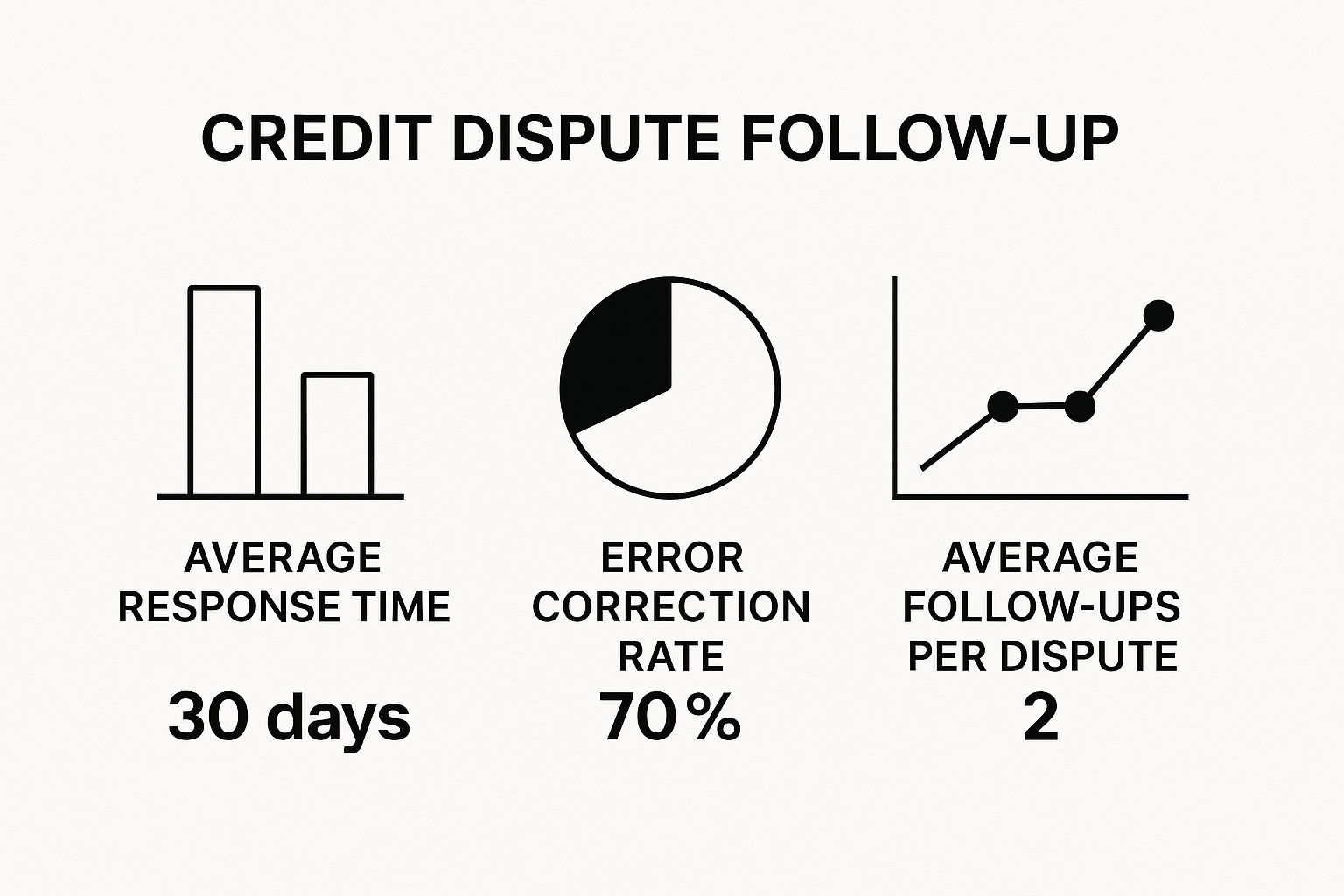
As you can see, a lot of disputed errors do get corrected, but it doesn't always happen overnight. Sometimes, it takes a bit of persistence.
Managing the Outcome of Your Dispute

Sending off your dispute packet feels like a huge accomplishment, but your work isn't quite over. Now comes the hard part: waiting. The credit bureaus generally have 30 to 45 days to investigate your claim, so you'll need a bit of patience.
Once their investigation is complete, they'll mail you a written notification of the results. Your outcome will typically fall into one of three categories, and how you handle each one is crucial for getting this across the finish line.
When Your Dispute Is Successful
This is the news you’ve been waiting for! The bureau investigated, agreed with your claim, and has either corrected or completely deleted the inaccurate information. It’s a fantastic result, but you can't just take their word for it.
You still have a few follow-up tasks to lock in your win:
Fixing a major error, like getting a bogus late payment or a collection account removed, can give your credit score a real boost. Keep in mind, though, that these changes aren't always immediate. If you're watching your score closely, you might be wondering why your credit score is dropping or fluctuating. Often, it's just a lag while the credit scoring models catch up with the new information.
What to Do If the Error Remains
It’s a frustrating reality, but disputes don’t always work on the first try. You might get a letter saying the creditor has “verified” the information as accurate, which means the error stays right where it is. This is a setback, but it’s definitely not the end of the road.
This is where persistence really pays off. It's a surprisingly common problem; a 2015 FTC follow-up study found that about 70% of consumers who had previously disputed an error still felt their report was inaccurate. The reward for sticking with it is significant, as an earlier study showed about 20% of consumers who corrected errors saw their scores improve enough to get better loan terms.
If the bureau's investigation didn't go your way, you still have some powerful options at your disposal:
Answering Your Top Credit Dispute Questions
Once you dive into the world of credit disputes, you'll find it's natural for a bunch of "what if" questions to start popping up. Even after you've sent off your letters, you might be left wondering what comes next. Let's walk through some of the most common questions I hear from people learning to fix their own credit reports.
Getting solid, no-nonsense answers is what will keep you confident and moving forward.