A Guide to Credit Monitoring All Three Bureaus

True credit monitoring all three bureaus—Experian, Equifax, and TransUnion—is the only way to get a complete picture of your financial identity. Relying on just one report is like trying to guard your entire home by only watching the front door. You're leaving the back door and windows completely unprotected.
Why Monitoring All Three Credit Bureaus Is Essential
Think of your credit history as three separate professional résumés, with one held by each major bureau. In a perfect world, they’d all be identical, but that’s rarely the case. Lenders aren't actually required to report your financial activities to all three bureaus at the same time.
For instance, your auto loan might only report to Experian and Equifax, while your local credit union sends updates exclusively to TransUnion. This common practice creates unique data "fingerprints" at each bureau. An error on one report, like a misreported late payment, could be totally invisible on the other two. Even worse, a fraudster might open a new credit card that only appears on your Equifax report. If you're only watching Experian, you’d have no idea until the damage is already done.
The Three Major Credit Bureaus at a Glance
Each bureau acts as an independent record-keeper of your financial life. Because lenders can pick and choose which bureau to report to (and pull from), you need visibility into all three to avoid nasty surprises.
Ultimately, what one bureau knows, the others might not. Monitoring all three closes these gaps and gives you a complete, accurate view of your credit.
The Problem With Blind Spots
These blind spots aren't just theoretical; they have very real consequences. When you apply for a mortgage, a car loan, or even a new apartment, you have absolutely no control over which credit report the lender will pull. They could deny your application based on a single negative item on a report you never even knew existed.
This gets to the heart of why single-bureau monitoring is so risky.
A Unified View for Total Security
Comprehensive credit monitoring all three bureaus eliminates these dangerous blind spots once and for all. It gives you a 360-degree view of your financial life, ensuring that what you see is exactly what lenders see, regardless of which bureau they consult.
This is why the industry itself is growing so rapidly. The global credit bureaus market was valued at 124.4 billion in 2023** and is projected to skyrocket to **385.6 billion by 2032. As consumer credit becomes more central to our lives, the need for complete visibility is more important than ever. You can explore the full research on this market expansion to see just how critical this has become.
The image below shows how true credit protection works by overseeing all three bureaus equally.
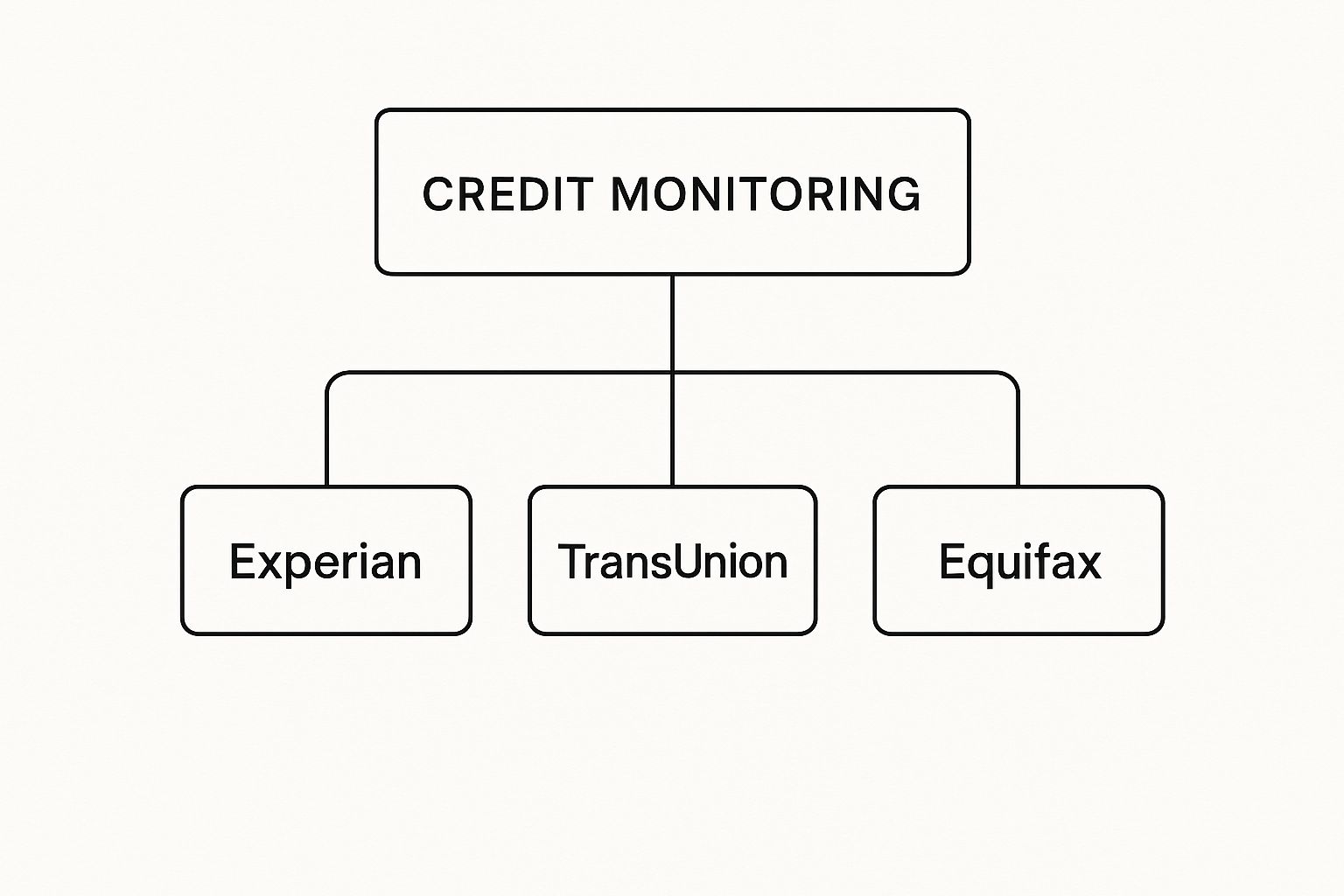
This unified approach means no more guesswork.
Understanding Your Three Separate Credit Reports
Think of your credit reports as three distinct professional résumés. Each one is managed by a different company—Experian, Equifax, and TransUnion—and while you'd expect them to tell the same story about your financial life, they often have surprising differences. You wouldn’t send out three different résumés for a job hunt without making sure each one was perfect, right? After all, you never know which one the hiring manager will actually see.
The same exact logic applies to your credit. Lenders, landlords, and even some employers can pull your file from any one of the three bureaus. A small, lurking error on just one report—completely invisible on the other two—could be the very thing that gets your loan application denied or saddles you with a higher interest rate. These discrepancies aren't outliers; they happen because each bureau is a separate business, gathering its own data.
Why Your Credit Reports Differ
So, why the variation? It's pretty simple: creditors aren't legally required to send your account information to all three bureaus. This voluntary system means each bureau ends up with a unique "fingerprint" of your financial data.
Here’s how this plays out in the real world:
This patchwork reporting means your fantastic on-time payment history for your car might not even appear on your Experian report, holding your score back. On the flip side, if you miss a payment on that loan, it would only hurt your standing with TransUnion and Equifax, leaving Experian untouched. This is exactly why monitoring just one bureau gives you a dangerously incomplete picture of your true credit health.

What’s Inside Each Credit Report
Even with different information, the basic layout of your credit reports is fairly standard across the board. Getting familiar with these sections is the first step to catching mistakes and making sure everything is accurate. For a more detailed breakdown, our guide on all three credit bureaus dives deeper into their specific roles.
Here’s a look at what you’ll find inside each report:
Since any of this information can be different from one bureau to the next, a complete review of all three is non-negotiable. Services that offer credit monitoring all three bureaus are built specifically to catch these inconsistencies, empowering you to fix problems before they can do any real damage.
The Real Benefits of Triple-Bureau Monitoring
It's one thing to know your credit reports can be different, but it’s another thing entirely to see how those differences can affect your money in the real world. The power of using credit monitoring across all three bureaus goes way beyond just having more information. It gives you real, tangible protection and opens up opportunities that single-bureau services just can't match.
I've found the benefits really boil down to three main pillars: catching fraud everywhere, ensuring your credit reports are truly accurate, and making smarter financial moves. Each one protects you from a specific blind spot that opens up when you're not watching your whole financial picture.
Comprehensive Fraud Detection
Think about it this way: if a burglar knew you only had a security camera on your front door, where would they try to break in? They'd go straight for a back window or a side door, knowing they're in a blind spot. Financial fraud works the exact same way.
Criminals are clever and opportunistic. They know that many lenders only report to one or two of the credit bureaus. So, a thief might apply for a new store credit card in your name, but they'll do it with a bank they know only reports to a bureau you aren’t watching. That bogus account pops up on your TransUnion report, but your monitoring service is only showing you what's on Experian.
From your perspective, everything looks fine. But behind the scenes, a delinquent account is quietly wrecking your credit. You might not find out until months later when you apply for a mortgage and get a nasty surprise. Comprehensive monitoring slams those backdoors shut.
Complete Credit Report Accuracy
Here’s a hard truth: errors on credit reports are way more common than people think. A Federal Trade Commission (FTC) study revealed that a staggering one in five consumers had a confirmed mistake on at least one of their credit reports. An error on one report is bad enough, but if that same mistake is on two or three, it can be financially devastating.
These aren't just typos. Common errors include:
If you aren’t monitoring all three reports, you might catch and dispute an error with Equifax, only to have the exact same mistake live on with Experian and TransUnion. You might celebrate a small score bump, not realizing the other two reports are still showing damaging information to lenders. To be truly credit-healthy, you need to make sure all three of your financial "résumés" are spotless.
Empowered Financial Decision Making
At the end of the day, the point of watching your credit is to use it to your advantage. When you're ready to apply for a big loan for a house or a car, you want to put your best foot forward. But if you can only see a third of the picture, you're walking in blind. You have no idea what the lender is about to see.
Will they pull your squeaky-clean Experian report with its high score? Or will they happen to pull your Equifax report, which has a small collection account you never knew about? That kind of uncertainty can lead to an instant denial or a much higher interest rate.
A 20-point difference in your credit score can easily cost you thousands of extra dollars in interest over the life of a car loan. Triple-bureau monitoring gets rid of that guesswork. You see exactly what's on every report, giving you the chance to fix problems before you apply. This confidence allows you to shop for loans knowing you’re presenting your strongest profile, no matter which bureau a lender checks. For more tips on managing your credit, you can find valuable insights on the All3Credit blog.
Choosing the Right Credit Monitoring Service

Trying to pick a service for credit monitoring all three bureaus can feel a bit like wading into deep water. There are so many options, and they all seem to promise the same thing. But making the right choice is one of the smartest moves you can make to protect your financial identity. Getting reports from Experian, Equifax, and TransUnion is just the starting point. Real protection comes from the features that actually help you when a threat appears.
Think of it this way: you wouldn't buy a home security system that only had a single sensor on the front door. You'd want the whole package—cameras, motion detectors, and a direct line to emergency services. Your credit monitoring should be that complete, multi-layered defense for your financial life.
Core Features Beyond Basic Reporting
To really figure out which service is best for you, you need to look past the flashy marketing and focus on the practical tools that will actually make a difference. A great service isn’t just about spitting data at you; it's about delivering timely, understandable information and having your back when you need it most.
Here are the key features you should absolutely insist on:
These features are what turn a simple report into a powerful shield.
The Critical Role of Restoration and Insurance
Monitoring is your first line of defense, but what if a determined thief manages to break through? This is where identity theft insurance and restoration services become non-negotiable. The financial and emotional nightmare of cleaning up after identity theft can be overwhelming.
In 2023 alone, consumers and financial institutions reported losses of over $10 billion to fraud. That number shows you just how devastating the fallout can be. While a security freeze is a fantastic preventative tool for blocking unauthorized access to your credit files, you still need a plan for the worst-case scenario.
This is where the real value comes in:
Without that kind of hands-on support, you’re left to fight that battle alone. A monitoring service without restoration is like a smoke alarm with no fire department on call—it tells you there's a fire but leaves you to put it out yourself. This is why a comprehensive platform like https://www.all3credit.com is built to provide that complete circle of protection, from alerts and monitoring to the expert help you need to restore your identity.
How Global Economic Shifts Affect Your Credit

It’s easy to think of your credit report as just a quiet history of your past debts. In reality, it’s a living document, and it’s surprisingly sensitive to the economic news you see on TV every night. Things like inflation and interest rate hikes aren't just abstract concepts—they directly impact your ability to borrow money.
Why? Because lenders and credit bureaus are always watching these big-picture economic trends to figure out their own level of risk. When the economic forecast looks stormy, they adjust their lending practices accordingly. This is precisely why credit monitoring all three bureaus is so crucial. It’s not just about spotting identity theft; it’s about understanding where you fit into a much larger, constantly moving financial puzzle.
How The Economy Influences Lenders
When you hear that a central bank is raising interest rates to curb inflation, what that really means is that it's about to get more expensive for banks to borrow money. And you can bet they'll pass that cost right on to consumers like you.
Suddenly, that credit score that got you an easy car loan approval last year might not cut it anymore. Lenders start tightening their belts. They might look for higher scores, demand lower debt-to-income ratios, or scrutinize your job history more closely before saying yes. By monitoring your reports, you can see where you stand right now and anticipate these changes instead of getting blindsided by a loan rejection.
This economic ripple effect touches several parts of your financial life:
Tracking Trends for Future Success
Getting a handle on these connections helps you switch from playing defense with your credit to playing offense. When you watch your reports from Experian, Equifax, and TransUnion, you get a front-row seat to how these macroeconomic forces are affecting you personally. Are your credit limits changing? Are you still getting pre-approved offers? These are clues that act as your own personal economic barometer.
This proactive view lets you make smart, strategic decisions. For instance, if you see experts predicting interest rate hikes, you might focus on aggressively paying down any credit cards with variable rates. On the flip side, if rates are dropping, that could be the perfect signal to refinance your mortgage or auto loan.
We see consumers around the world react to these signals. A great example comes from the Equifax Q1 2025 Global Consumer Credit Trends report. It showed that mortgage refinancing in Australia jumped by a massive 20% year-over-year right after a rate cut. People saw an opportunity to lower their payments and they acted fast. By keeping a close eye on your own credit, you can be just as nimble and ready to make the most of these opportunities when they appear.
Got Questions About 3-Bureau Monitoring? We've Got Answers.
Even after seeing how crucial it is, you probably still have a few questions about how credit monitoring across all three bureaus actually works. That's completely understandable. Let's walk through some of the most common questions people ask so you can feel confident about protecting your finances.
Is Monitoring All Three Bureaus Really That Important?
In a word: yes. Lenders aren't obligated to send your account details to all three credit bureaus. One of your credit cards might report to Experian and TransUnion, while your auto loan only reports to Equifax. This is just how the system works.
If you’re only watching one bureau, you have a massive blind spot. A fraudulent account, a late payment that was actually an error, or the first signs of identity theft could easily pop up on a report you aren't watching. You might not find out for months, and by then, the damage could be done, resulting in a sudden credit score drop or a loan denial right when you need it most. You need a complete, 360-degree view to be truly protected.