Top Picks for Best Credit Monitoring Services in 2024

When you start looking for the best credit monitoring services, a few names consistently pop up: All3Credit, IdentityForce, and Aura. These are often considered the front-runners because they deliver on the essentials—monitoring all three credit bureaus, offering substantial identity theft insurance, and sending out alerts in real-time.
Your final choice really comes down to what you value most. Are you looking for the most robust protection possible, or do you need a solid service that fits a tighter budget? The features and pricing can vary quite a bit, so it's worth taking a closer look.
A Closer Look at the Top Credit Monitoring Services
Picking a credit monitoring service is a big decision for protecting your financial health. The market is crowded, but the truly great services all have a few things in common. They provide comprehensive monitoring across Equifax, Experian, and TransUnion, include significant identity theft insurance, and give you immediate notifications if something looks off. Think of these as the non-negotiables for solid protection.
Where these services really start to differ is in the details. You'll find variations in how they handle family plans, how deep their dark web scanning goes, and even how intuitive their mobile apps are. Some are designed for someone who just wants to keep an eye on their credit score, while others offer a full suite of identity restoration services designed to cover an entire household. Nailing down what you actually need is the first step to finding the right fit.
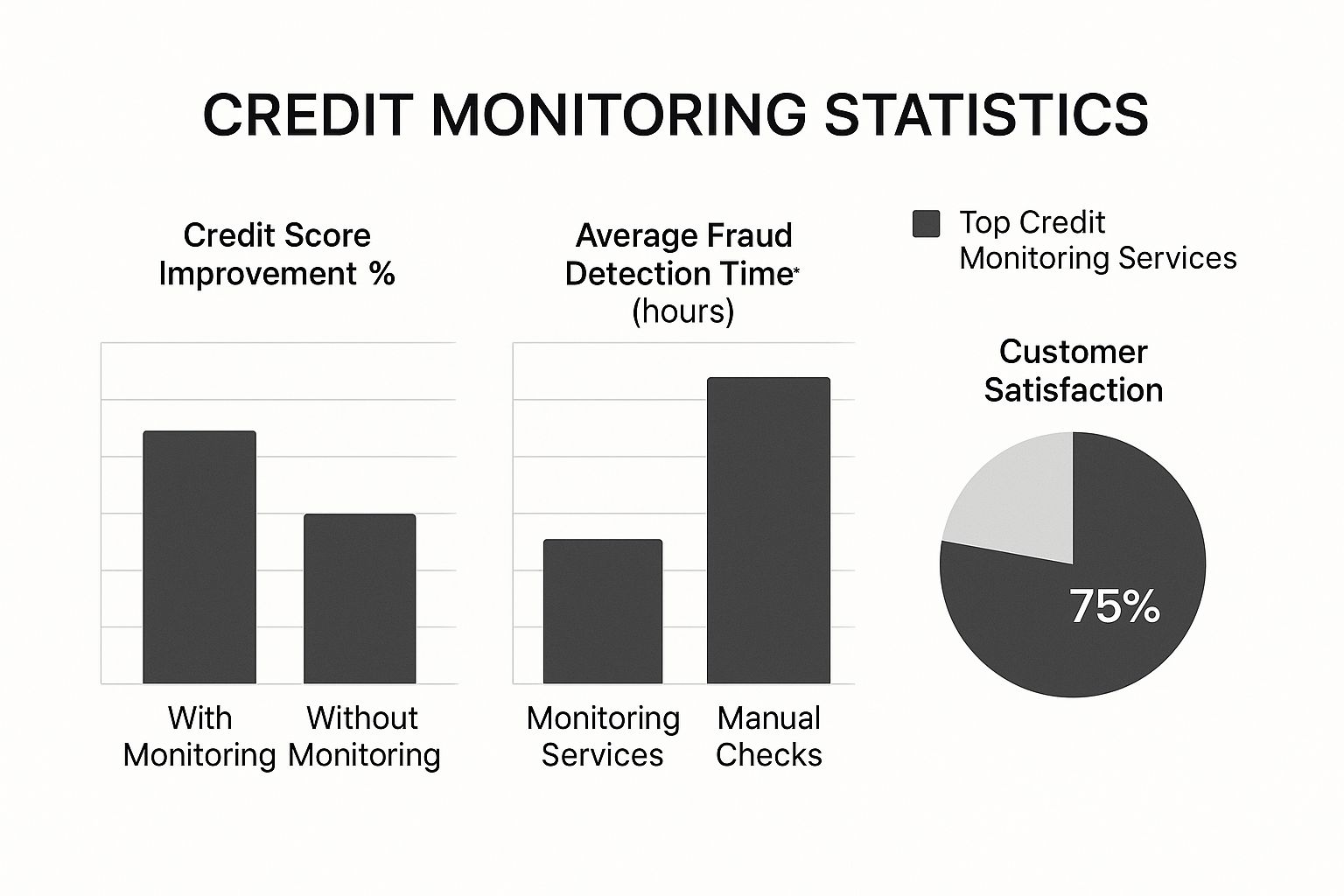
The image above really drives home the point: being proactive with credit monitoring pays off. It's not just about potentially boosting your credit score; it's about drastically shortening the time it takes to spot and shut down fraud.
To make things simpler, I've put together a table that breaks down what each of the leading services brings to the table. This should give you a quick, at-a-glance idea of where they stand.
Top Credit Monitoring Services at a Glance
This table offers a snapshot of the top contenders, highlighting their strengths and who might find them most useful.
As you can see, the pricing and features are geared toward different needs. All3Credit is a fantastic entry point, while services like Aura bundle in extra tech security that families might appreciate.
Why Credit Monitoring Is Now Essential
Let's be honest: in the past, credit monitoring felt like an optional add-on, a "nice-to-have" for the extra cautious. Those days are long gone. With data breaches becoming a regular headline, thinking of it as anything less than essential is a serious gamble with your financial health. It’s now your first line of defense against identity theft and fraud.
These services keep a close eye on your credit reports with the three main bureaus—Equifax, Experian, and TransUnion—and give you a heads-up the moment something changes. That speed is crucial. Criminals are getting smarter, and a new credit card or an unexpected loan application appearing under your name is often the first red flag. Without monitoring, you might not spot this kind of trouble for months, giving thieves plenty of time to wreck your finances.

The Growing Threat of Identity Theft
The rise in identity theft isn't just a feeling; the numbers back it up. We’re seeing more sophisticated schemes that make it incredibly difficult for anyone to keep their information safe on their own. This is where the best credit monitoring services step in, offering an automated, round-the-clock watch over your most critical financial data.
This shift in awareness is driving huge market growth. The identity theft protection and credit monitoring market was valued at a staggering USD 6.2 billion in 2024 and is expected to more than double by 2033. It’s a clear signal that people are moving from a reactive to a proactive mindset when it comes to protecting their money.
By alerting you in near real-time, these services give you the power to act immediately.
How Proactive Monitoring Safeguards Your Finances
At the end of the day, the goal is to stop financial loss and protect your identity before the real damage is done. A good monitoring service is like a digital security guard, flagging suspicious activity that you’d almost certainly miss otherwise.
Here’s what that protection looks like in practice:
This layer of security is fundamental to financial wellness today. If you want to get into the nitty-gritty of how it all works, you might find our guide on what credit monitoring is helpful.
A Detailed Comparison of Core Features

When you start shopping for a credit monitoring service, it’s easy to get lost in the marketing noise. You have to look past the shiny promises and really dig into what each feature means for you. Terms like "three-bureau monitoring" get thrown around a lot, but what they deliver can vary wildly. Knowing the difference is how you find a service that genuinely has your back.
Let's pull back the curtain on the most important features. We'll compare what the top services offer and show you how All3Credit stacks up, so you can see the real-world value behind each one.
Three-Bureau Monitoring In Practice
Just about every serious credit monitoring service will tell you they offer three-bureau monitoring. The problem is, the depth of that monitoring isn't always the same. Some services might just give you updated scores from Experian, Equifax, and TransUnion. That’s a start, but it's not the full picture. Real protection means monitoring your full credit reports.
A truly comprehensive service alerts you to the nitty-gritty details, like a new hard inquiry or a credit card you didn't open. That’s information you can act on, unlike a vague score drop. For example, with All3Credit, you get direct access to your bureau data—you’re seeing what lenders see, not just a simplified summary.
Think about it: if a service only watches one or two bureaus, you're leaving a door wide open. A thief could open an account with a creditor that only reports to Experian, and if your service is only tracking TransUnion, you'd be completely in the dark.
Identity Theft Insurance
Identity theft insurance is another area where you have to read the fine print. You'll see big numbers like $1 million in coverage, but it's crucial to know what that money is actually for. This insurance is about reimbursement, not a payout.
It's designed to cover the direct costs you face while cleaning up the mess, such as:
The insurance doesn't just cut you a check for the amount a thief stole. It pays you back for documented, out-of-pocket expenses. Frankly, a service with a top-notch restoration team who walks you through the recovery process is often more valuable than one with a slightly higher insurance limit but little hands-on support.
Social Security and Dark Web Scans
Your Social Security Number is the skeleton key to your financial life. That's why the best credit monitoring services include SSN monitoring. It specifically scans for your number being used with a name or address that isn't yours—a massive red flag that standard credit monitoring might miss.
Likewise, dark web scanning is a proactive feature that constantly searches those hidden corners of the internet for your personal information, from passwords and email addresses to credit card numbers. No service can see the entire dark web, but a good scan gives you a critical head start if your data shows up after a breach.
Here’s a practical example: say your email and password from a hacked retail website are found for sale. A dark web alert gives you the chance to change your passwords everywhere else before a criminal can try using that same login information to get into your more sensitive accounts. It turns a potential disaster into a manageable inconvenience.
Comparing Pricing Plans and Real Value
When you’re shopping for a credit monitoring service, the price tag is usually the first thing you see. But that number rarely tells the full story. The real value isn't just about the monthly fee; it's about what that fee actually gets you. A cheap plan might look great on the surface, but if it's only watching one credit bureau or offers flimsy support when fraud hits, you’ve bought yourself a false sense of security.
The trick is to find that sweet spot where affordability meets real, comprehensive protection. It means digging deeper than the monthly cost to see what you're actually getting. The best services out there strike a perfect balance, offering a strong feature set that gives you genuine peace of mind without breaking the bank.
What You Get at Different Price Points
Credit monitoring services can range anywhere from free all the way up to over $30 a month for family plans packed with extras. Knowing what to expect at each level is crucial for making a smart choice.
This search for effective protection is exactly why the U.S. identity theft services market was valued at about 5.6 billion in 2024**. That number is expected to climb to **5.7 billion in 2025, according to IBISWorld, as more people seek reliable ways to defend against the rising tide of fraud.
Analyzing the Real Return on Investment
When you’re weighing your options, think about your investment in terms of risk reduction. A plan that comes with $1 million in identity theft insurance and a dedicated team to help you recover your identity provides enormous value. Suddenly, that monthly fee looks tiny compared to the thousands of dollars and hundreds of stressful hours you could spend trying to clean up the mess on your own.
For most people, the cheapest plan is rarely the most cost-effective one in the long run. We dive into the details of what to look for in our guide to finding the cheapest credit monitoring service that doesn’t skimp on protection. At the end of the day, the best value is a service that covers your specific needs without making you pay for bells and whistles you’ll never touch. It all comes down to a personal cost-benefit analysis based on your financial life and risk tolerance.
How to Choose the Right Service for You
Picking the right credit monitoring service really isn't a one-size-fits-all deal. What works for your neighbor might be completely wrong for you. It all comes down to your financial habits, your personal risk factors, and frankly, what keeps you up at night. Don't get distracted by the service with the longest list of features; focus on matching the protection to your actual life.
The best way to do this is to think about real-world situations. Are you constantly punching in your credit card details on new websites? Or are you a parent trying to keep an eye on your kids' financial futures as they head off to college? Each scenario demands a different kind of protection. Once you know what you're trying to protect, making the right choice becomes much easier.
For the Frequent Online Shopper
If you live and breathe online, your biggest worry is probably a data breach exposing your sensitive information. You need a service that’s more like a watchdog than a monthly report, with aggressive alerts and broad digital security.
Your must-haves are:
For the Family with Young Adults
When you’re managing the financial well-being of a whole family, a single-user plan just won't cut it. You're not just protecting your own credit anymore; you’re a guardian of your children's financial identities, which are prime targets for fraud.
Look for a robust family plan that includes:
This strategy wraps a layer of security around your entire household. It's especially critical as young adults start navigating student loans, first apartments, and credit card applications on their own.
For Someone Recovering from Identity Theft
If you’ve already been through the nightmare of identity theft, your needs are on a totally different level. You're not just trying to prevent future fraud—you're in active recovery mode and need a team in your corner.
Your focus should shift to services that prioritize restoration and support:
What's Really Going On Behind the Scenes of Credit Monitoring?

To really get why the best credit monitoring services are so valuable, it helps to peek under the hood and see how they actually work. At the most fundamental level, every single service is plugged into the three major credit bureaus: Experian, Equifax, and TransUnion. Think of these bureaus as the massive libraries of our financial lives.
These bureaus gather and organize an incredible amount of our financial data, from mortgage payments to every last credit card swipe. A credit monitoring service connects directly to these sources, acting as your personal lookout. The real magic, though, isn't just in watching the data feed; it's in how modern services process that information to find red flags.
How Advanced Analytics Changed the Game
Not too long ago, monitoring was a pretty simple affair. You'd get a notification for basic changes, and that was about it. Today's top-tier services have brought in heavy hitters like artificial intelligence (AI) and machine learning to do the hard work. These systems don't just report changes—they actively hunt for patterns that scream "fraud."
So, instead of a flat alert that a new account was opened, these smarter systems can connect the dots. They might see a credit application filed with a new address that doesn't match any of your past locations or spot an inquiry using a strange mix of your personal details. It’s this deeper level of analysis that turns a simple score-tracking tool into a genuine security partner.
This technology is fueling a massive industry. The entire credit bureaus market, which powers these services, was valued at 109.59 billion in 2024** and is projected to reach **191.22 billion by 2029. A huge part of that growth comes from integrating machine learning and using more detailed financial data. You can find more details about the growing credit bureau market on TheBusinessResearchCompany.com.
This sophisticated technological foundation is precisely why paid services can offer much more robust protection. They're investing in the powerful infrastructure needed to not only monitor your credit but to analyze it for threats with incredible precision, giving you a real edge in protecting your financial identity.
Got Questions About Credit Monitoring? We Have Answers.
It's completely normal to have questions when you're looking into protecting your credit. Let's walk through some of the most common ones so you can feel confident in choosing the right service.
Are Free Credit Monitoring Services Good Enough?
Honestly, it depends on what you mean by "good enough." Free services, like the ones your bank or a credit card company might offer, are a decent starting point. They usually keep an eye on your report from just one of the major credit bureaus. While that's certainly better than flying blind, it leaves some pretty big gaps in your financial security.
The real problem is that lenders don't all report to the same bureau. A new fraudulent account could pop up on your Experian report, but if your free service only watches TransUnion, you'd never know. This is where paid services like All3Credit really shine by offering comprehensive 3-bureau monitoring.